Independent. Impartial. Certified.
For municipalities and provincial authorities

A standard you cannot enforce is not a standard.

Short-term rental registration requires someone to physically confirm what each property holds. STRCAS is accredited capacity to do that — without adding a single position to your headcount.

The arithmetic

The problem is not the standard. It's the visiting.

Seven or more separate compliance areas per property — zoning, electrical, gas, fire, health, business licensing, insurance — each held by a different party and expiring on a different date. None of it can be confirmed from a desk. Somebody has to go to the property.


Approximately 90,000 short-term rental properties, divided by the 440 one assessor can physically cover in a working year, equals 205 assessors each working a full year.
The assumptions are printed on the graphic so you can argue with them. The conclusion survives it — halve the property count and double the daily rate, and it is still more than fifty assessor-years.
The options

There are three ways to close it.

Presented honestly, including what the third one costs you.

1. Hire inspectors

Permanent headcount, payroll, pensions, training, union agreements — and in most cases a hiring freeze standing in the way. Slow to build, impossible to scale down.

2. Do nothing

The current position. The standard exists on paper, non-compliance carries no practical consequence, and the properties that do comply gain nothing for it.

3. Accredit a paid-per-job network

No headcount. Scales with application volume and costs nothing in a quiet month. What it costs you: you must be satisfied the accreditation is real, the independence holds, and the quality is monitored. That is what the rest of this page is about.

Why the third option works

Enforcement has never had a funding model.

This is a structural problem, not a failure of intent — and it is why frameworks across many sectors get written faster than they can be administered.

The structural issue

An inspector is a cost line. Nothing in the way enforcement is funded causes capacity to grow when applications grow. Volume rises, the establishment does not, and the backlog becomes the policy.

That gap is not closed by better intentions or another circular. It is closed by changing who carries the cost of capacity and when they carry it.

What an accredited network changes

The people doing the work are paid per job. Their income depends on volume being processed and their standing depends on being rated well for it — so capacity expands with applications and contracts when there are none, without a budget cycle in between.

The commercial incentive and the enforcement objective point in the same direction. That alignment is the mechanism.

The division of labour

Neither side can do this alone, and neither should. Setting the standard, holding the authority and making the determination are public functions. They cannot be privatised, and we are not asking to hold them.

What the private sector can do is build, fund and carry the risk of a national assessment network before anyone has committed to using it — because there is a viable business in doing that well.

Privatising enforcement would mean handing over the decision. This does the opposite: every decision stays where it is, and what changes is that those decisions become actionable.

An empty municipal committee room.

The decision to enforce gets made in rooms like this. The capacity to enforce does not exist in them.

The process

Where STRCAS sits in your pipeline.

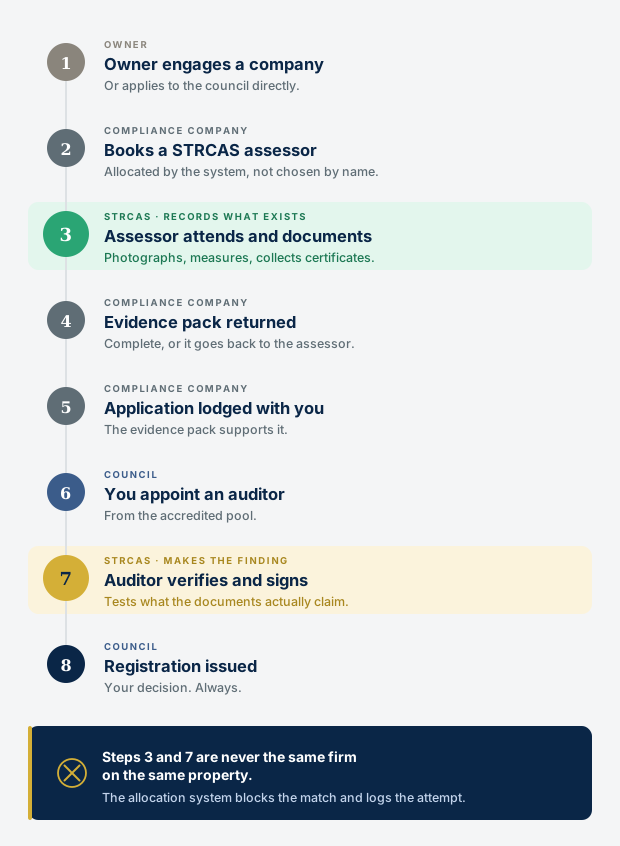
Eight steps, four parties. STRCAS appears at two of them — step 3, where somebody has to physically attend the property, and step 7, where somebody independent has to verify what came back.

Nowhere else. It is not in the application, not in the decision, and not in the register.

The council issues the registration. STRCAS does not certify properties, does not grant licences, and holds no decision-making authority.

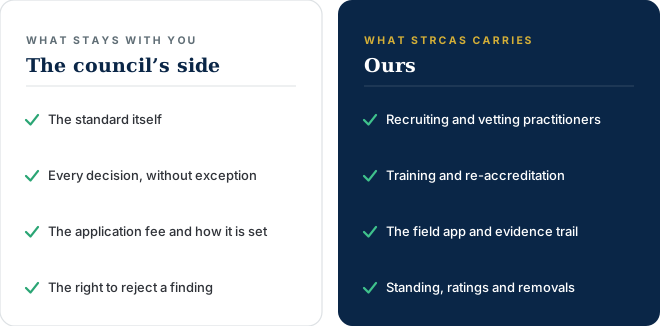
What stays with the council: the standard, every decision, the application fee, and the right to reject a finding. What STRCAS carries: recruiting and vetting practitioners, training and re-accreditation, the field app and evidence trail, standing, ratings and removals.
The eight-step registration process across four parties, read top to bottom, showing the two points at which STRCAS supplies capacity.

STRCAS never issues the registration. The council does. It supplies accredited people at the two points that need feet on the ground and an independent signature.

Where the owner applies directly, steps 1–5 collapse and the council books the assessor itself.

Who checks the checkers

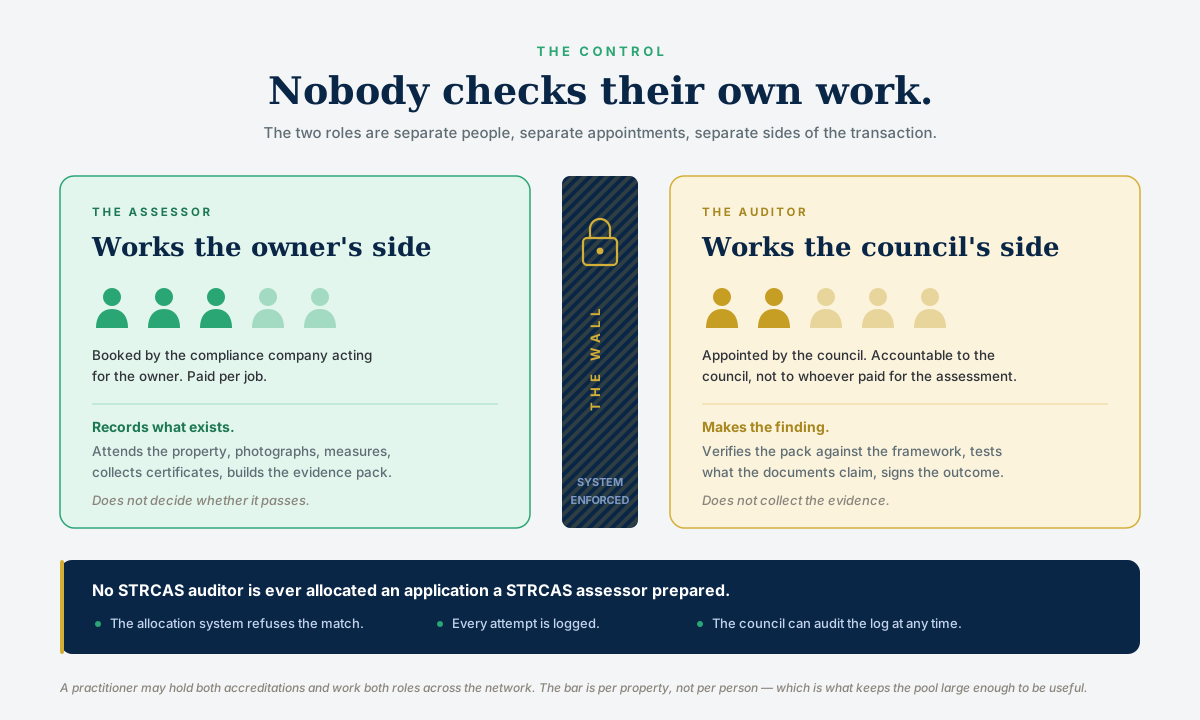
The assessor and the auditor are never the same person.

This separation is the whole basis on which a sign-off means anything.

Assessor

Works the owner's side.

Records what exists.

  • Attends the property in person, every time
  • Photographs, measures, collects certificates of compliance
  • Completes the checklist against the applicable requirements
  • Produces an evidence pack — makes no determination
Auditor

Works your side.

Verifies the record against the standard.

  • Appointed by the council, accountable to the council
  • Interrogates the pack for consistency and completeness
  • Issues findings — pass or fail per requirement, with reasons
  • Signs off, and stands behind the finding if challenged

The allocation rule: no STRCAS auditor is ever assigned to an application prepared by a STRCAS assessor. This is enforced in the allocation system, logged, and available for you to audit — not a policy statement, a control.

The independence wall: assessors work the owner's side and record what exists; auditors are appointed by the council and make the finding.
The bar is enforced per property, not per person — which is what keeps the accredited pool large enough to be useful while still making self-review impossible.
Independence

The wall between advising and auditing.

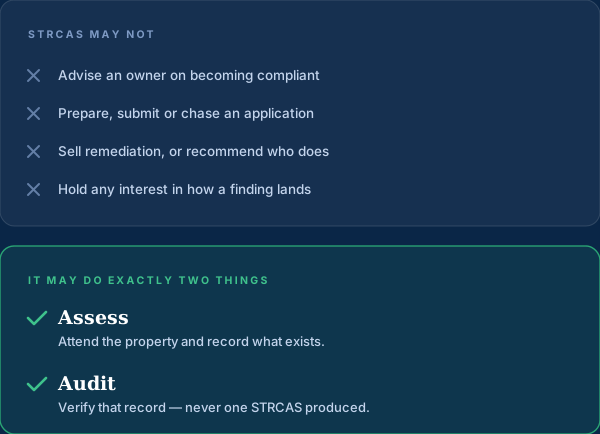
What STRCAS may not do: advise an owner on becoming compliant, prepare or submit an application, sell remediation, or hold any interest in how a finding lands. What it may do: assess, by attending the property and recording what exists, and audit, by verifying a record it did not produce.

STRCAS does not advise property owners. An assessor who also sells the fix has an interest in what they find — which is the failure mode this business is built to avoid.

That has to be structural rather than verbal:

  • An auditor cannot be assigned to an application a STRCAS assessor prepared — the system blocks it and logs the attempt
  • Published rate card for every compliance company, and the same queue, whoever is booking
  • Full access for your office to the allocation log at any time

If STRCAS advised owners, it could not credibly audit them. That wall is not a constraint on the business — it is the business.

Quality control

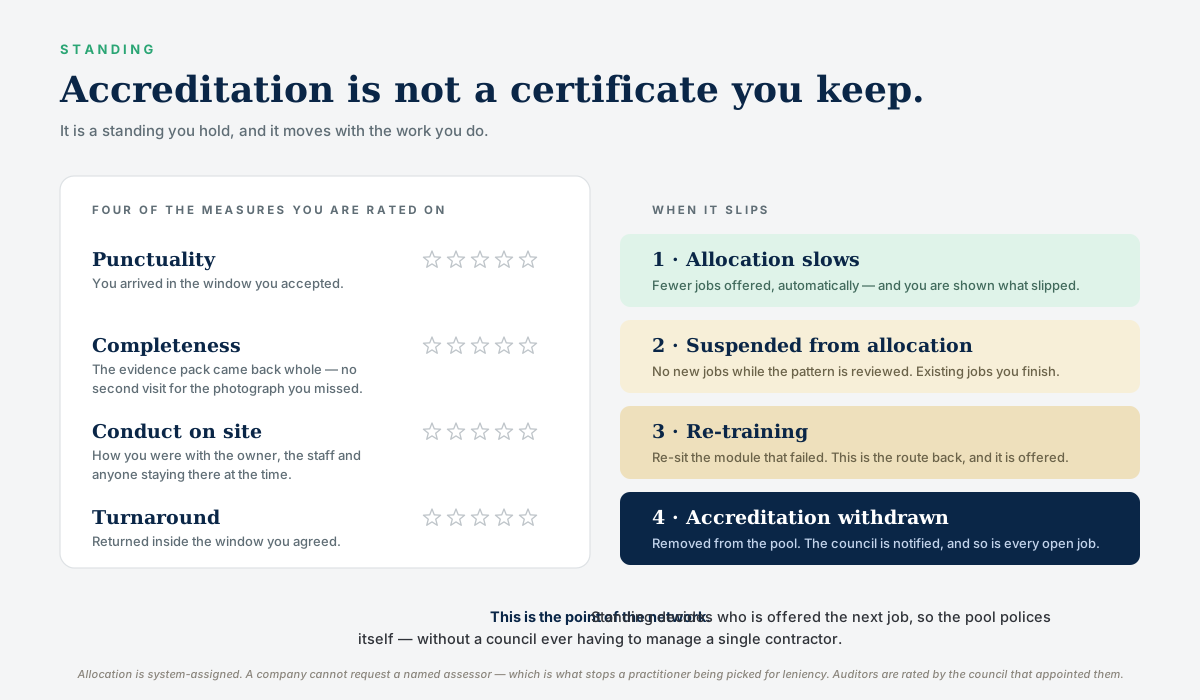
Accreditation is point-in-time. Standing is continuous.

You are not appointing from a list of names. Every practitioner carries a live rating, and the rating governs whether they keep working.

What every practitioner carries

  • Punctuality — arrived in the window they accepted
  • Completeness — the pack came back whole, first time
  • Conduct on site — with the owner, staff and any guests present
  • Turnaround — returned inside the agreed window

These four are the ones a booking party scores directly. They are not the whole rubric — audit outcomes, rejected evidence and disputed findings feed the same standing.

Nobody gets to request a named assessor. Allocation is assigned by the system on area, availability and standing. A company that could choose its own assessor could choose a lenient one — or a friend — and the evidence pack would be worth nothing to you. Declining an allocation is allowed; the reason is logged.

Assessors are rated by the party that engaged them. Auditors are rated by the council that appointed them — never by the party whose property they assessed. Otherwise they would be under pressure to pass.

Example · what you see when an assessor is allocated
Sofia Daniels
Accredited Assessor · STRCAS-A-0417
Cape Town Metro · Southern Suburbs
Good standing
4.8average across 63 completed assessments
Punctuality4.9
Completeness4.7
Conduct on site5.0
Turnaround4.6

Plus audit outcomes, rejected evidence and disputed findings — scored by the system, not by the booking party.

Allocated, not chosen. You see this record after the assignment is made. No party selects a practitioner by name, and every decline is logged against the account that made it.

Annual re-accreditation applies to everyone, whatever their standing — assessors and auditors alike.

The four rating dimensions and the consequence ladder that follows a rating that slips.
A council cannot realistically rate an individual contractor it never sees. It can rate a pool — and the pool polices itself, because standing decides who is offered the next job.
How the work is controlled

Nobody is paid for a submission that has not been verified.

An assessor is not paid for attending a property. They are paid once the submission has been checked and the work found correct. A pack that comes back short goes back to them — unpaid — until it is complete.

That ordering is deliberate. Paying on attendance buys you visits. Paying on verified output buys you evidence.

And they do not work on their own tools

Every assessment is captured in proprietary software supplied by Short-Term Rental Compliance Management Systems (STRCMS). Mobile in the field, desktop for review.

  • Evidence captured in the app, against the checklist for that property type
  • An incomplete submission cannot be submitted — the gate is in the software, not in a reminder
  • Certificates authenticated and stored against the property record, not the assessor
  • Every action timestamped and attributable to a named accredited practitioner
  • Your office sees the same record, from the same system

This is why the record holds up. An assessor cannot photograph a board on their phone, email it from a personal account and have it counted. If it did not go through the system, it did not happen.

The STRCMS field app on a phone: a completion dial, a checklist with some items ticked and others still open, and a grid of captured property photographs each marked as accepted.
What it costs you

Nothing, until there is work.

  • No permanent positions, no payroll, no pension liability
  • No procurement of permanent staff, no hiring-freeze conflict
  • Paid per job — a quiet month costs nothing at all
  • Capacity scales with application volume, in both directions
  • No software to procure, licence or maintain — the practitioners carry that
What it creates

Accredited local work.

Assessors are recruited and trained in the areas they cover — retired electricians, fire officers, building inspectors and plumbers, property practitioners, and built-environment graduates.

Every accreditation is a local person carrying a credential and earning from it. In areas with available trade skills and high unemployment, that may matter more locally than the compliance argument does.

What's actually at stake

This is not a paperwork exercise.

Every requirement in the compliance stack traces back to somebody having been hurt.

Nobody currently knows

A guest booking a South African property has no way to establish whether the gas installation was ever certified, whether the electrical CoC is current, or whether the fire escape is obstructed.

Nor does the platform

Booking platforms rely on guest reviews — written after the stay, by people with no way to inspect what matters. A review is a lagging indicator of a safety failure, not a control against one.

And the exposure isn't only the guest's

A serious incident in unregulated accommodation becomes a sector event and a municipal one. Tourism runs on trust, and trust is rebuilt far more slowly than it is lost.

An enforced framework does three things at once. It protects guests from conditions they cannot assess themselves. It protects compliant operators from being undercut by those carrying none of the cost of compliance. And it gives the sector — and your office — a defensible answer when someone asks what standards actually apply and who checks them.

The part nobody has

How many of your short-term rentals are actually compliant?

No municipality in South Africa can currently answer that question. Not approximately, not by suburb, not by category of failure. An accredited assessment network generates that picture as a by-product of doing the work.

Discuss reporting
Reporting available

Aggregate compliance picture

  • Compliance rate by ward and suburb
  • Most common points of failure
  • Properties assessed but never lodged
  • Certificates approaching expiry
  • Assessment volume and turnaround
For government only

Request a meeting.

This reaches an account manager directly, not a general inbox. It is for municipal, provincial and national government — the conversation covers what your framework will require, where your capacity constraint sits, and the revenue split.

Not in government? This form is not for you, and we would rather say so than waste your time. Compliance companies and managing agents should book an assessor. Property owners should speak to a compliance company — STRCAS does not work directly with owners. Everyone else, contact us.

Please use your official government address. We do not action requests from personal email accounts.

Handled under POPIA. Never sold, and never shared with any advisory business.